
 Back to the news page
Why another hand? Meet Origin Hand
Advanced myoelectric hands can offer remarkable capabilities, yet adoption remains low. Estimates suggest that only around 5% of people who could benefit from a myoelectric hand actively use one, and many people stop using their device within the first 18 months after fitting.
After years of researching and developing prosthetic hands, we kept returning to three barriers: devices can be expensive to buy and repair, they often provide no tactile feedback, and they can be uncomfortable to wear. We created Origin Hand to take a different approach to each of those challenges.
Haptic cues and simpler repairs
Origin Hand provides continuous haptic cues through multiple channels. These device-generated signals are designed to indicate when an object is held and how firmly you are gripping it.
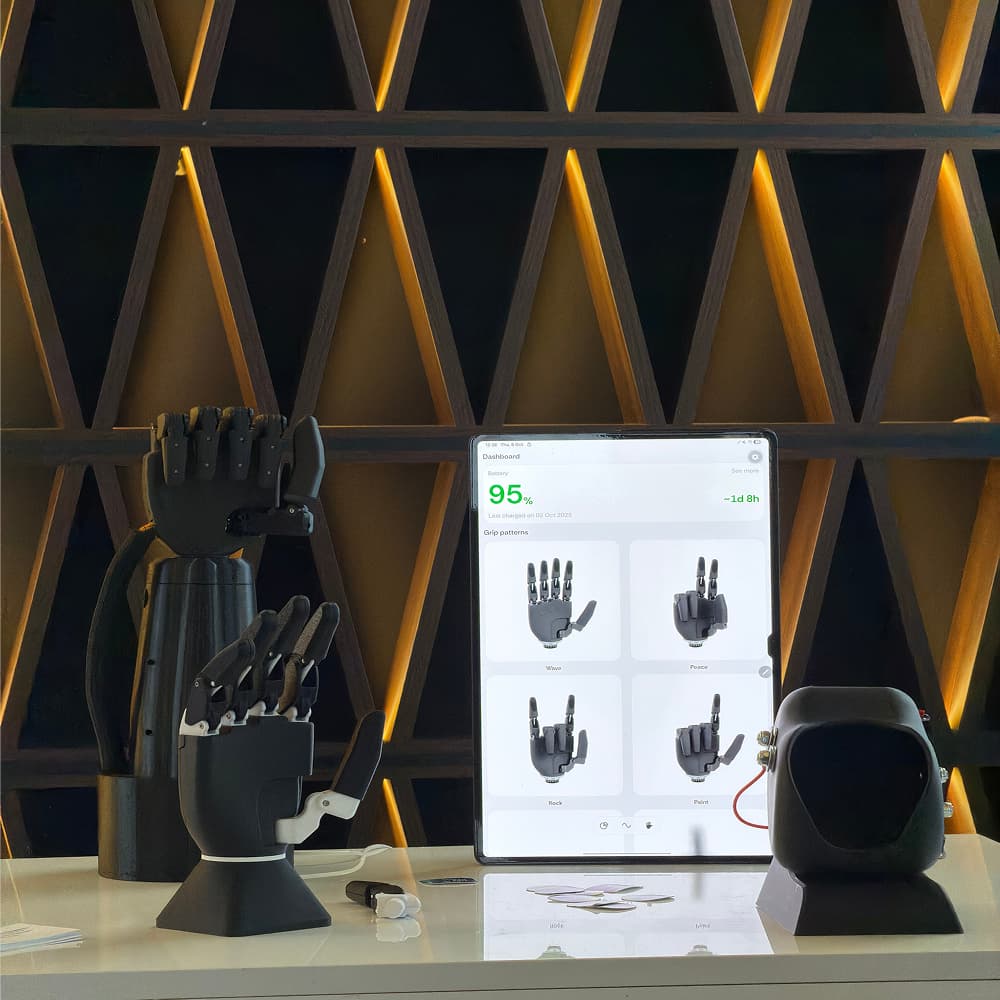
The hand is modular, so individual fingers can usually be replaced at a prosthetics clinic without sending the whole device back to our workshop. The system also monitors motor and battery life, and the Origin Companion app can let you know when a check-up may be due.
In the standard M-size QWD configuration, Origin Hand weighs under 500 g. We know comfort matters in everyday use, so keeping the device lightweight has been an important part of its design.
Designed for demanding moments
Origin Hand is designed to withstand loads of up to 35 kg in four-finger hook mode and up to 90 kg across the palm. These figures are durability metrics, not recommended everyday lifting limits. They are intended to give users confidence when supporting themselves, for example when rising from a chair or exercising.
Make it your own
Self-expression matters. We left the back of the hand clear so it can become your canvas. Send us a graphic you would like to have engraved, and we will engrave it on the backplate free of charge.
You can also adjust the gripping force up to 110 N and set the finger closing speed, with a full flexion as fast as 0.8 seconds. Through the mobile app, custom gestures and grip patterns can be added to suit different routines and lifestyles.
Designed with privacy in mind
Origin Companion does not require an account or sign-in. The app connects to the hand over Bluetooth. The data collected is limited to information needed to monitor the health of the battery and motors, hand movement and operation of the haptic-feedback system, so we can help ensure the device works properly and improve these features over time.
Making access part of the design
We are committed to making Origin Hand as affordable as possible and to working with reimbursement systems. A prosthetic hand is not a luxury: it is an assistive device that enables people to work, exercise, perform, participate in society and live more independently.
We are not announcing a final price yet. Our goal is to keep the hand accessible as we move through the remaining development and authorisation steps.
What comes next?
Origin Hand has reached mechanical design freeze. We are now focused on integrating the final materials and getting the remaining details right to support a smooth authorisation process. We plan to make the hand commercially available in Europe first, during the second half of 2027.
The first version planned for prosthetics clinics is M size, with a smaller option to follow. We are also expanding our clinical partnerships so more clinics can offer Origin Hand from launch.
Thank you
To the clinics, patients, business partners and Origin supporters who have helped bring this project forward: thank you. Your feedback and belief in what we are building mean a great deal to the whole Origin Team. ❤️